Iterava
FLOW SPHERE
FLOW SPHERE
Couldn't load pickup availability
Self-paced learning overview
- 📥 Digital file available after purchase
- 🗂️ Long-term availability
- 🔒 Secure checkout
- 🗓️ Content updated in 2026
1. Problem Statement
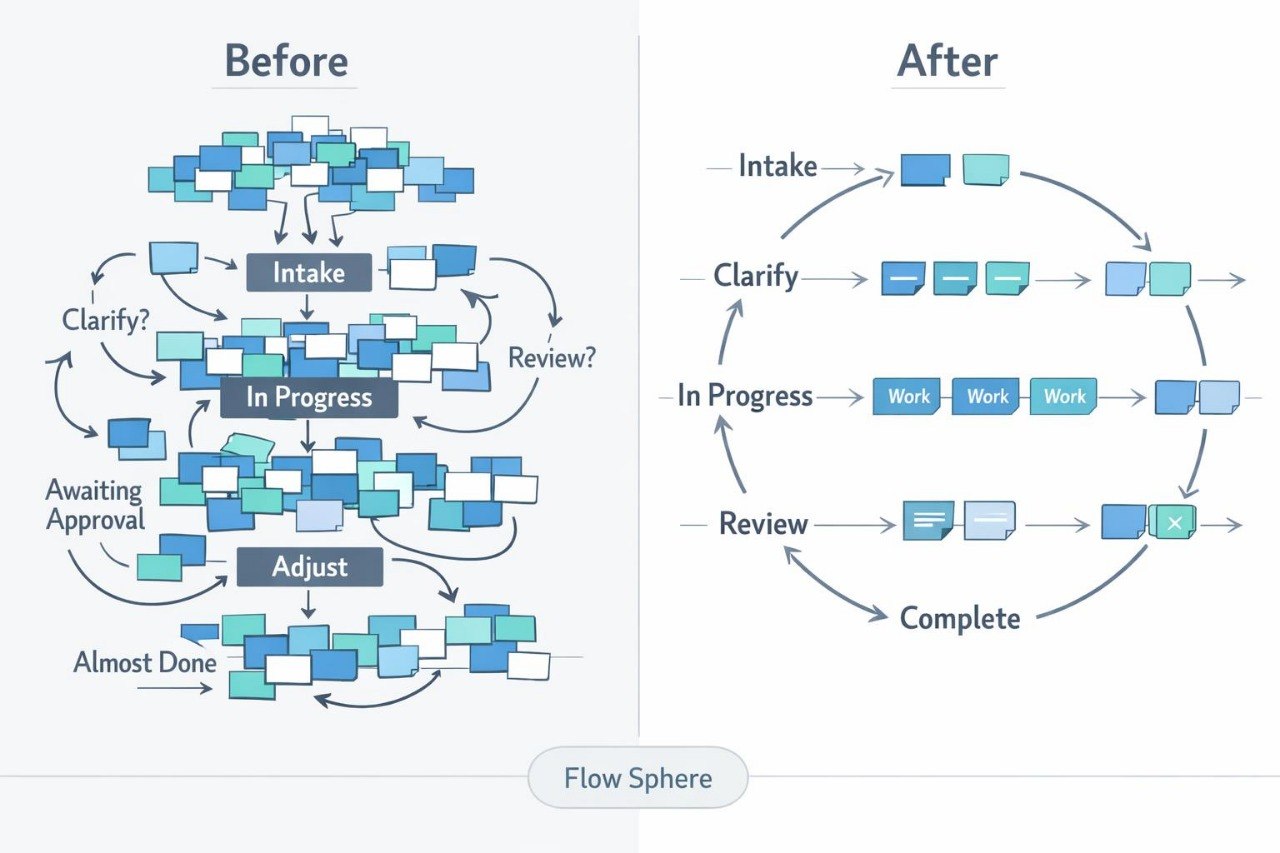
Struggling to maintain steady project movement when new tasks arrive regularly and different stages carry different workloads? You are not alone: a team may begin many activities while completion depends on reviews, clarification, and decisions from other contributors. Tasks can accumulate between stages, dates may shift, and assigned contributors may not see the underlying cause of a delay. Additional requests may enter the workflow without an assessment of their effect on work that is already planned. Without a shared flow model, it becomes harder to locate overloaded stages, identify activities requiring attention, and revise the working sequence.
2. Solution
This course will teach you to view a workflow as a connected system covering task intake, active work, review, and completion. You will learn how to map stages, count active tasks, and identify areas where unfinished work begins to accumulate. The course explains how to create rules for receiving new requests, revising task order, and coordinating reviews between teams. You will learn to conduct recurring flow analysis and distinguish a temporary delay from a repeated structural issue. Practical exercises will guide you through building a Flow Sphere for a digital project containing several interdependent workstreams.
3. What’s Inside
Module 1: Flow System Overview
Create an overview of work movement from the first request to the closing review and identify the main handoff points between contributors.
Module 2: Intake Structure
Prepare a process for receiving new tasks, clarifying context, assigning ownership, and checking whether an activity is ready to begin.
Module 3: Work-in-Progress Mapping
Learn how to observe the number of active tasks at every stage and examine why too many simultaneous activities can make completion harder.
Module 4: Queue and Delay Analysis
Identify queues, waiting periods, repeated reviews, and other points where tasks stop moving through the project.
Module 5: Flow Priorities
Review task order according to dependencies, dates, team workload, and the effect each activity has on connected work areas.
Module 6: Review and Approval Paths
Describe review routes, handoff conditions, assigned reviewers, and the sequence of actions following requested revisions.
Module 7: Flow Signals
Define indicators for observing workflow conditions, including active task count, waiting time, repeated returns, and completed work within a selected period.
Module 8: Flow Adjustment Sessions
Prepare a team review format covering delays, workload distribution, priority changes, recurring issues, and follow-up actions.
Module 9: Multi-Stream Coordination
Compare several workstreams and identify how a delay in one area affects other stages, teams, or project outcomes.
Module 10: Flow Sphere Model
Complete a full project flow model containing stages, queues, intake rules, review routes, handoffs, and observation indicators.
4. Who Is This For?
✅ This course may suit you if you:
- coordinate several workstreams at the same time;
- work with a large list of active and planned tasks;
- examine delays between teams or project stages;
- define how new requests enter the workflow;
- want a clearer view of workload and unfinished work;
- already know how to create project frameworks, dependency maps, and coordination rules.
❌ This course may not suit you if you:
- are beginning with foundational Digital Project Management concepts;
- work on one independent activity;
- do not participate in planning, reviews, or task distribution;
- need materials focused only on defining an initial project goal;
- do not intend to examine a working flow through practical exercises.
5. What You’ll Learn
After completing Flow Sphere, you will be able to:
- map the complete movement of a task from request to completion;
- divide a workflow into at least six working stages;
- define rules for receiving and clarifying new tasks;
- count active activities across each part of the workflow;
- identify queues, repeated returns, and waiting points;
- map review and approval routes;
- prepare a set of indicators for recurring observation;
- conduct a team review of workload and delays;
- coordinate several connected workstreams;
- create a complete Flow Sphere model for a learning or workplace scenario.
6. Refund Terms
A refund request for Flow Sphere may be submitted within 30 calendar days of the purchase date. Requests are reviewed according to the published Iterava policy, enrollment conditions, and the amount of material already studied. Review the course outline and current submission procedure before completing enrollment.
7. Certificate
After completing all modules and submitting the final workflow model, the learner receives an Iterava certificate. The document records completion of Flow Sphere: Digital Project Flow Coordination.
1. Do I need previous Digital Project Management experience?
1. Do I need previous Digital Project Management experience?
No. Iterava courses are organized step by step, beginning with core concepts and roles before moving into planning, coordination, documentation, and workflow analysis. The depth of the materials gradually increases with each plan.
2. How are the courses organized?
2. How are the courses organized?
Each course contains thematic modules, written explanations, working examples, diagrams, review questions, and practical assignments. You can study the materials at your own pace and return to earlier topics while completing the exercises.
3. How long does a course take?
3. How long does a course take?
The study time depends on the number of modules, the complexity of the assignments, and your personal learning rhythm. Each plan contains a different amount of material, so advanced plans require additional time for careful study.
4. Is a certificate included?
4. Is a certificate included?
Yes. After completing every module and the final assignment, the learner receives an Iterava certificate. It includes the course name and confirms completion of the learning program.
Share